
Not every tile that looks good indoors belongs on a patio or pool deck. Outdoor tile has to handle direct sun, sprinkler overspray, pool chemicals, bare feet running across a wet surface, and San Diego's occasional cold snap, all without cracking, fading, or turning into a slip hazard. Pick the wrong tile and you get hairline cracks by year two, a deck that is genuinely dangerous when wet, or grout lines that bleach out and crumble within a summer or two.
We install porcelain and natural stone tile on patios, pool decks, and outdoor kitchens across San Diego County, and the material choice matters as much as the installation. This guide covers water absorption ratings, slip resistance (DCOF), frost considerations, and expansion joint placement, the four things that actually determine whether outdoor tile lasts or fails.
Planning a patio or pool deck project? Request a free in-home estimate or call +1 (619) 777-4334.
What Makes a Tile Suitable for Outdoor Use
The number that matters most for outdoor tile is water absorption rate, which measures how much moisture the tile body soaks up. The ASTM C373 test sorts tile into four classes: impervious (0.5 percent absorption or less), vitreous (0.5 to 3 percent), semi-vitreous (3 to 7 percent), and non-vitreous (over 7 percent). Only impervious and vitreous tile belong outdoors. Semi-vitreous and non-vitreous tile, which includes most standard glazed ceramic wall and floor tile sold for interior use, soaks up water that then expands and contracts with temperature and sun exposure, cracking the tile body or popping it loose from the mortar bed within a few seasons.
Through-body porcelain, where the color and pattern run all the way through the tile rather than sitting in a thin glazed surface layer, is the standard choice for exterior work. Because the color is not just a surface glaze, small chips from furniture drags or pool toys do not show a different-colored core underneath, and the tile holds up to UV exposure without the surface finish wearing through to a duller layer below.
What Slip Rating Do You Need for a Wet Pool Deck?
Slip resistance is measured with the DCOF (Dynamic Coefficient of Friction) test under ANSI A137.1, the current U.S. standard that replaced the older static coefficient of friction test. For a level interior floor, ANSI sets a minimum wet DCOF of 0.42. Pool decks and patios need considerably more grip than that because the surface is wet far more often, exposed to sunscreen and pool chemical residue, and walked on barefoot. We specify a minimum wet DCOF of 0.60 for pool decks, and manufacturers of pool-specific porcelain often publish an R rating from the German DIN 51130 ramp test alongside the DCOF number, with R10 or R11 being the typical target for a poolside surface.
Texture is what creates that grip, not color or price. Look for a tile description that specifically lists a wet-rated or pool-rated finish, usually a fine structured or lightly textured surface rather than a smooth polished one. Polished porcelain and polished natural stone, no matter how attractive in a showroom, are not appropriate within a few feet of a pool edge or anywhere water regularly sits on the surface.
Frost Rating and Freeze-Thaw Risk in San Diego's Climate
Frost rating comes from the ASTM C1026 freeze-thaw test, which cycles a saturated tile sample through 12 rounds of freezing and thawing to see if it cracks or spalls. In a true freeze climate this rating is non-negotiable. San Diego's coastal neighborhoods rarely see freezing temperatures at all, but inland communities we serve, including Poway, Escondido, and higher-elevation pockets of San Marcos, do get a handful of nights each winter that dip to or just below 32 degrees.
Because tile with 0.5 percent absorption or lower simply cannot hold enough moisture to freeze and crack in the first place, choosing impervious or vitreous porcelain solves the frost question automatically, whether the project is on the coast or inland. It also protects the manufacturer's exterior warranty, which is typically voided if a non-rated tile is installed outdoors regardless of climate. We treat frost-rated porcelain as the default for every outdoor tile job we quote, coastal or inland, since the cost difference between frost-rated and non-rated porcelain is minimal and the failure mode (a cracked paver that has to be chiseled out and replaced) is not.
Best Tile Types for Patios and Pool Decks
Three material categories cover nearly every outdoor project we install:
| Material | Water Absorption | Best Use | Notes |
|---|---|---|---|
| 2cm (20mm) porcelain pavers | Under 0.5% | Pool decks, raised patios, pedestal systems over roof decks | Thick enough to lay dry over pedestals with drainage below; the standard for new pool construction |
| Standard porcelain tile (10mm) | Under 0.5% | Ground-level patios, covered lanais, walkways | Mortar-set over a concrete slab; needs an exterior-rated thinset and grout |
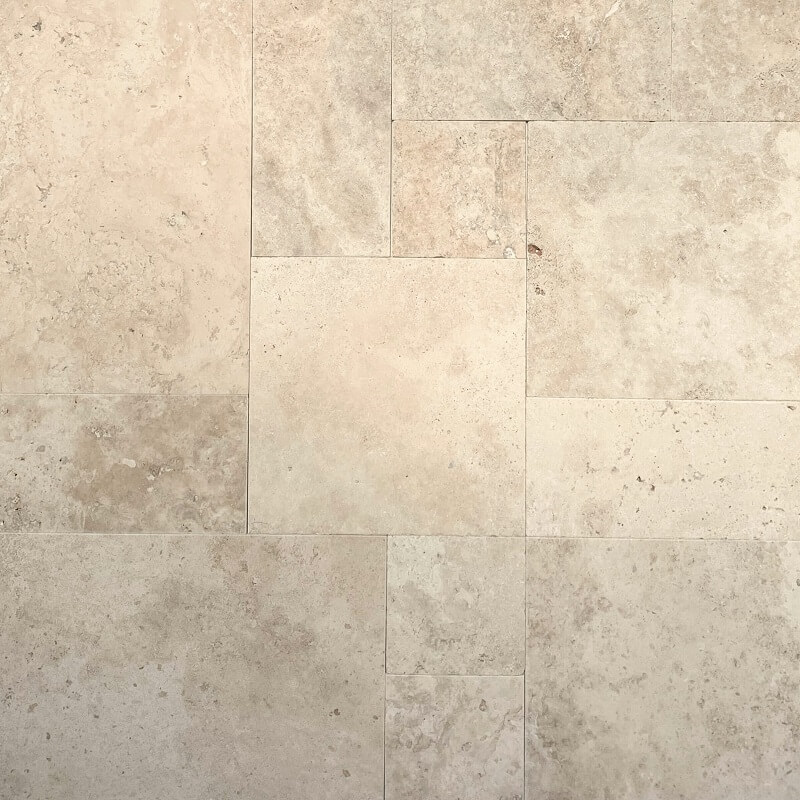
| Travertine (honed or tumbled) | Varies, needs sealing | Pool coping, decks, classic Mediterranean-style patios | Naturally textured surface grips well wet; requires resealing every 1 to 2 years |
| Standard glazed ceramic | 3% to 7%+ | Not recommended outdoors | Absorbs water, not frost-rated, cracks and delaminates outdoors within 1 to 3 years |
Pool coping (the cap tile at the pool edge) deserves separate mention. It needs a rounded or bullnose profile with no sharp corners, a slip rating on the high end of what we specify for the rest of the deck, and enough thickness (usually 1.25 to 2 inches) to span the bond beam properly. Travertine coping is still the most common choice in San Diego because it stays noticeably cooler underfoot in direct sun than most porcelain, which matters on a 90-degree August afternoon.
For covered patios, lanais, or transition areas that stay mostly dry and out of direct weather, some homeowners also look at luxury vinyl plank as an indoor-outdoor flow option. LVP is not rated for direct sun or standing water exposure, so we only recommend it for fully covered spaces that function more like an extension of the interior than a true exterior surface.
Expansion Joints and Movement Joint Placement
Outdoor tile moves more than indoor tile because it experiences a much wider daily temperature swing, easily 40 to 50 degrees between a cool San Diego morning and a hot mid-afternoon slab surface. Without movement joints, that expansion and contraction has nowhere to go, and the tile field eventually cracks, tents, or pushes tiles up at the seams (a failure called tenting).
The Tile Council of North America addresses this directly in guideline EJ171, which we follow on every exterior tile install. In practice that means:
- Movement joints every 8 to 12 feet in both directions across the open field of tile, filled with a flexible polyurethane or silicone sealant, never rigid grout.
- A movement joint at every change of plane, such as where a patio meets a step, a pool deck meets the coping, or tile meets a slab control joint underneath.
- Perimeter joints around the full edge of the tiled area, where it meets a wall, house foundation, or planter, using the same flexible sealant instead of grout.
- Matching any existing control joint in the concrete slab below, since a joint in the slab that is tiled over solid will telegraph a crack straight through the tile above it.
You can review the published guideline directly through the Tile Council of North America, which maintains the industry's installation handbook referenced by manufacturers and inspectors alike.
Installation Considerations for Pool Decks and Patios
Beyond material selection, three installation details separate a pool deck that lasts 20 years from one that needs repair in five:
Slope for drainage. Every pool deck and patio needs a slope of roughly 1/4 inch per foot away from the house and away from the pool edge, so water sheets off the surface instead of pooling against grout lines or the home's foundation. Standing water on outdoor tile accelerates efflorescence (a white mineral haze) on natural stone and speeds up grout breakdown everywhere.
Setting method. Ground-level patios get a full mortar bed or thinset directly over a properly sloped concrete slab. Raised pool decks or roof decks more often use a pedestal system, where 2cm porcelain pavers rest dry on adjustable pedestals with open gaps underneath for drainage, no mortar or grout joints at all. Pedestal systems also make it far easier to access plumbing or drains beneath the deck later without demolishing tile.
Grout and joint material. Standard cement grout holds up outdoors, but for pool decks exposed to constant chlorine or saltwater chemical splash, we typically recommend a polymer-modified or epoxy grout, which resists chemical staining and does not absorb pool water the way standard sanded grout can over years of exposure. Saltwater pools in particular are harder on standard grout and any exposed metal edging, so the joint material is worth upgrading on a saltwater pool project even if the tile itself is identical.
We handle every stage of this from slope-checking the existing slab to sealing the final movement joints. See our full tile flooring installation process for how we approach material selection and layout before a single tile goes down, and browse our San Diego flooring services overview if you are also weighing interior flooring alongside an outdoor project.
Cost to Install Outdoor Patio and Pool Deck Tile
Costs below are fully installed, including exterior-rated setting materials and movement joint sealant, for a standard ground-level or pedestal installation:
| Material | Installed Cost/sqft | 300 sqft Patio Total |
|---|---|---|
| Standard porcelain tile (10mm, mortar-set) | $9.00 - $16.00 | $2,700 - $4,800 |
| 2cm porcelain pavers (mortar-set) | $12.00 - $20.00 | $3,600 - $6,000 |
| 2cm porcelain pavers (pedestal system) | $16.00 - $24.00 | $4,800 - $7,200 |
| Travertine (honed or tumbled) | $14.00 - $26.00 | $4,200 - $7,800 |
Pool coping typically adds $18 to $35 per linear foot depending on profile and material, since coping is cut and finished differently than field tile. Add $2 to $4 per square foot if the existing slab needs slope correction or crack repair before tile can go down. This is one of the most common surprise costs on older San Diego pool decks, since many were poured flat rather than sloped to drain. Homeowners across La Jolla, Coronado, and Rancho Santa Fe in particular often have older pool decks from prior decades that need this correction as part of a re-tile. Our free in-home estimate includes a slope check and a firm price before any demolition starts.
Frequently Asked Questions
What Is the Best Tile for a Pool Deck?
Through-body porcelain with water absorption under 0.5 percent and a wet DCOF slip rating of at least 0.60 is the best choice for most pool decks. Honed or tumbled travertine is a strong second option and stays cooler underfoot in direct sun, but it needs resealing every 1 to 2 years to stay water-resistant.
Does Pool Deck Tile Need to Be Frost Rated in San Diego?
Coastal San Diego rarely freezes, but inland areas like Poway, Escondido, and parts of San Marcos do see occasional nights near or below 32 degrees. Frost-rated porcelain costs little to no more than non-rated porcelain and keeps the manufacturer's warranty intact, so we install it as the default on every outdoor project regardless of exact location.
What DCOF or Slip Rating Should Pool Deck Tile Have?
We specify a minimum wet DCOF of 0.60 for pool decks, above the ANSI A137.1 baseline of 0.42 for level interior floors. Many pool-rated porcelain products also list an R10 or R11 rating from the DIN 51130 ramp test, which is a good secondary check when comparing options.
Can You Use Ceramic Tile Outdoors?
Standard glazed ceramic tile is not recommended outdoors. It typically absorbs 3 to 7 percent or more water, is not frost-rated, and tends to crack or delaminate within 1 to 3 years of sun and moisture exposure. Impervious or vitreous porcelain is the correct substitute for the same look with real durability.
How Far Apart Should Expansion Joints Be on a Patio?
Following TCNA guideline EJ171, movement joints should be placed every 8 to 12 feet in both directions across the tile field, plus at every perimeter edge and any change of plane, such as where the patio meets a step or the pool coping.
Is Natural Stone or Porcelain Better for a Pool Deck?
Porcelain needs less long-term maintenance since it does not require sealing and holds its color under UV exposure. Natural stone like travertine stays cooler underfoot in direct sun and has a more traditional look, but it needs periodic sealing to resist staining and water absorption. Many pool decks use travertine for the coping and porcelain for the main deck field.
How Much Does It Cost to Tile a Pool Deck?
Expect $12 to $24 per square foot installed for porcelain pavers, or $14 to $26 per square foot for travertine, depending on thickness and whether the tile is mortar-set or installed on a pedestal system. Pool coping adds $18 to $35 per linear foot on top of the deck field cost.
Can Porcelain Tile Crack in Freezing Temperatures?
Porcelain rated impervious or vitreous (0.5 to 3 percent water absorption or lower) holds so little moisture that there is not enough water inside the tile body to expand and crack it when it freezes. Non-rated tile with higher absorption can crack in freeze-thaw cycles, which is why frost-rated porcelain is worth specifying even in a mild climate like San Diego's.