
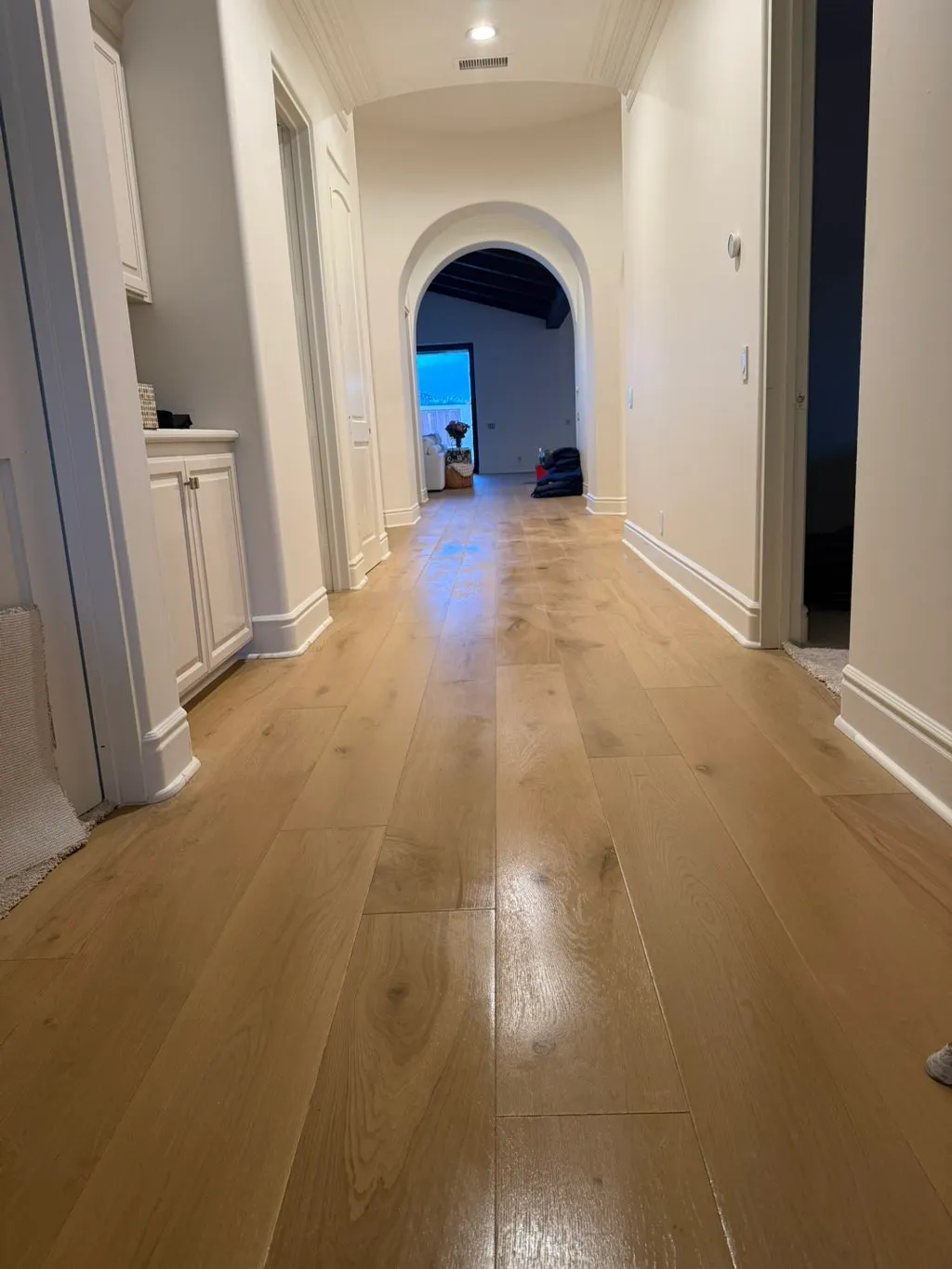
Flooring in a rental property gets used differently than flooring in a house you live in. A homeowner's floor sees one household's habits for a decade or more. A rental unit's floor sees a new tenant, new furniture, new pets, and new move-in scuffs every 18 to 36 months, and every day the unit sits vacant during a turn is rent the owner is not collecting. The material that wins in a landlord's home does not always win in a unit built to survive five or six tenancies without a full replacement.
We install and repair flooring for landlords, property managers, and portfolio investors across San Diego County, most often rigid-core LVP for full-unit turns, laminate for budget-conscious units, and VCT for larger apartment common areas. This guide breaks down which material fits which situation, what it actually costs per door, and how fast each one lets you turn a unit.
Managing a unit turn or a whole portfolio? Request a free in-home estimate or call +1 (619) 777-4334.
What Rental Property Flooring Actually Needs to Do
A rental floor has a different job description than a homeowner's floor. Industry turnover surveys put average apartment tenancy in the 24 to 30 month range, which means a floor installed today will likely see its first new tenant before its third birthday, and several more after that if it lasts. Every day a unit sits empty for a floor repair or replacement is a day of lost rent, commonly $50 to $120 a day depending on the unit and market, so the flooring decision is really two decisions at once: what survives repeated tenant wear, and what gets a unit back on the market fastest.
That changes the priority order compared to an owner-occupied home. Resale value and personal style still matter, but they rank behind three practical questions: does it resist scratches from move-in dollies and furniture drag, does it survive a slow leak or spilled water without buckling before you catch it, and can one damaged plank or tile be swapped without redoing the whole room. Materials that fail any of those three tend to cost landlords more in the second and third tenancy than they saved on the first install.
We work with owners managing anywhere from a single duplex to multi-building portfolios across the county, including properties in San Diego and Chula Vista, and the same four materials come up in almost every conversation: rigid-core LVP, laminate, carpet for bedrooms, and VCT for larger common areas.
Rigid-Core LVP for High-Turnover Units
Rigid-core luxury vinyl plank (the SPC, stone-plastic composite type, sometimes labeled WPC for the wood-plastic composite variant) is what we install in the large majority of full-unit rental turns we do. The wear layer that matters for rental use runs 12 to 20 mil, and we recommend staying at 20 mil or a commercial-rated 28 mil product for any unit with regular tenant turnover, since the wear layer is what stands between foot traffic and a scuffed, dull-looking floor.
The core is 100 percent waterproof, so a tenant's forgotten dishwasher leak, an overflowing tub, or a dropped drink does not become a subfloor problem the way it can with laminate or engineered hardwood. Click-lock installation runs $4.50 to $6.50 per square foot installed; glue-down (more common in ground-floor or slab units where you want a fully bonded floor) runs $5.50 to $7.50 per square foot. A crew of two typically installs 600 to 900 square feet a day, so an average 800 to 900 square foot one- or two-bedroom unit is floored in a single day, sometimes stretching to a day and a half with furniture removal and disposal of the old material.
The other reason LVP wins for rentals is spot repair. A rigid-core click-lock floor can have a single damaged plank pulled and replaced in under an hour if you kept a box of matching material from the original install, which is not true of sheet vinyl or most glue-down luxury vinyl tile. With normal rental wear, we see well-installed 20 mil rigid-core LVP hold up through 4 to 6 tenant cycles, roughly 10 to 15 years, before it needs full replacement.
When Laminate Still Makes Sense for a Rental Budget
Laminate still has a place in rental flooring, mainly on tighter per-door budgets or in units where moisture exposure is low, think second-floor bedrooms or units without a kitchen or full bath on that floor level. A commercial-grade AC4 or AC5 rated laminate installed runs $3.00 to $5.00 per square foot, roughly a dollar to a dollar fifty less per square foot than rigid-core LVP, which adds up fast across a 20 or 40 unit portfolio.
The tradeoff landlords need to understand going in: laminate's core is wood fiber, not the mineral-based core in LVP, so even moisture-resistant laminate is not truly waterproof at the seams. A tenant who does not immediately wipe up a spill, or a slow leak under a refrigerator that goes unnoticed for a few weeks, can cause swelling at the plank edges that is not repairable, only replaceable. For units with any real water exposure risk, kitchens, ground-floor units, bathrooms nearby, we steer owners toward LVP instead and reserve laminate for drier, lower-risk rooms and units.
Laminate's other rental advantage is scratch resistance at the surface layer, which handles move-in and move-out furniture drag well. Installed correctly with a proper underlayment, it also holds up acoustically better than some LVP products, which matters in multi-story buildings where a downstairs tenant complaint about footstep noise is a real management headache.
Does Carpet Still Make Sense for Rental Bedrooms?
Yes, in many San Diego rental markets carpet is still the right call for bedrooms, though not the builder-grade carpet many owners default to. Commercial-grade solution-dyed nylon or olefin carpet, 26 to 32 ounce face weight, resists staining better than residential-grade carpet because the color is baked into the fiber rather than applied afterward, so a spill can be scrubbed without bleaching a spot. Installed cost runs $2.50 to $4.00 per square foot including pad, generally the least expensive of the four materials covered here.
The honest tradeoff is lifespan. Where 20 mil rigid-core LVP commonly lasts 4 to 6 tenant cycles, rental-grade carpet in a bedroom typically needs replacement (not just cleaning) every 1 to 3 tenant cycles, roughly 3 to 6 years, depending on pets and tenant care. That shorter replacement cycle is why many owners now put carpet only in bedrooms and switch living areas, kitchens, and hallways to LVP, a mixed approach that keeps the lower per-square-foot cost of carpet where tenants still expect it (bedrooms) while avoiding it where wear and moisture risk are highest.
Carpet also remains relevant for value-tier and workforce housing where tenants and prospective renters still expect it in bedrooms, and for markets where the softer feel is a rent-ability factor. If pet-heavy tenancy is common in a portfolio, budget for the shorter replacement cycle rather than being surprised by it at the next turn.
VCT for Apartment Hallways and Common Areas
For larger multi-unit buildings, 8 units and up, VCT (vinyl composition tile) is the standard for hallways, laundry rooms, and lobby or common areas rather than individual units. VCT's cost advantage is significant, typically $2.00 to $4.00 per square foot installed, and it holds up to the kind of heavy, continuous foot traffic a shared hallway sees that no individual unit floor experiences.
The tradeoff is maintenance. VCT needs periodic stripping and rewaxing, generally every 12 to 24 months in a moderate-traffic hallway, to keep its finish and gloss, which is an ongoing line item property managers need to budget for rather than a one-time install cost. Individual tiles are inexpensive and easy to replace if damaged, which fits common-area use where a maintenance crew, not a tenant, is doing the repair.
We install VCT less often for interior unit floors themselves (rigid-core LVP now outperforms it there on waterproofing and maintenance) but it remains the most cost-effective option for the shared spaces of larger apartment buildings and multi-family properties throughout the county.
Cost and Turn Time by Material
Here is how the four materials compare for a typical 850 square foot one- or two-bedroom rental unit, fully installed:
| Material | Installed Cost/sqft | 850 sqft Unit Total | Typical Turn Time | Expected Life in Rental Use |
|---|---|---|---|---|
| Rental-grade carpet | $2.50 - $4.00 | $2,125 - $3,400 | 1 day | 3 - 6 years |
| VCT (common areas) | $2.00 - $4.00 | $1,700 - $3,400 | 1 - 2 days | 15 - 20 years (with periodic refinishing) |
| Laminate (AC4/AC5) | $3.00 - $5.00 | $2,550 - $4,250 | 1 - 2 days | 7 - 10 years |
| Rigid-core LVP | $4.50 - $7.50 | $3,825 - $6,375 | 1 - 2 days | 10 - 15 years |
Cost per square foot is only half the math. A carpet floor that needs full replacement every 4 years costs an owner more over a 12 year hold than an LVP floor installed once for a higher upfront price. When we quote portfolio owners, we usually run both numbers, the install cost today and the expected cost per year of service, since the cheaper material on day one is not always the cheaper material over a multi-tenant hold period.
Owners managing several doors also get a real discount from bundling. Ordering the same LVP product across 6, 10, or 20 units at once locks in material pricing and guarantees dye-lot matching for future spot repairs, both of which are harder to get once you are ordering one unit at a time as vacancies come up. If you're weighing flooring decisions for a portfolio spread across the county, from coastal units in La Jolla to inland properties, we can quote a standard spec across all of them in one visit.
Frequently Asked Questions
What Is the Best Flooring for a Rental Property?
Rigid-core LVP is the best all-around choice for rental units because it is fully waterproof, resists scratches from move-in and move-out traffic, and allows single-plank spot repairs between tenants. It costs $4.50 to $7.50 per square foot installed and typically lasts 10 to 15 years, or 4 to 6 tenant cycles, before needing full replacement.
Is Laminate or Vinyl Plank Better for Rental Units?
Rigid-core vinyl plank is better for units with any real moisture exposure, kitchens, ground-floor units, or bathrooms nearby, since its core is fully waterproof. Laminate costs about a dollar less per square foot and works fine in lower-risk rooms like upper-floor bedrooms, but a slow leak or unnoticed spill can cause swelling at the seams that vinyl plank does not have.
Should Landlords Still Put Carpet in Rental Bedrooms?
Yes, commercial-grade solution-dyed carpet still makes sense for many rental bedrooms at $2.50 to $4.00 per square foot installed. The tradeoff is a shorter replacement cycle, typically 3 to 6 years versus 10 to 15 years for LVP, so budget for more frequent replacement rather than switching materials only after a bad surprise at turnover.
What Flooring Is Best for Apartment Hallways and Common Areas?
VCT (vinyl composition tile) is the standard for multi-unit hallways, laundry rooms, and lobbies because it is inexpensive at $2.00 to $4.00 per square foot and holds up to constant shared-space foot traffic. It needs stripping and rewaxing roughly every 12 to 24 months to keep its finish, which should be budgeted as ongoing maintenance rather than a one-time cost.
How Much Does It Cost to Floor an Entire Rental Unit?
For a typical 850 square foot one- or two-bedroom unit, expect $1,700 to $3,400 for VCT, $2,125 to $3,400 for rental-grade carpet, $2,550 to $4,250 for laminate, or $3,825 to $6,375 for rigid-core LVP, fully installed. Actual cost depends on layout, subfloor condition, and whether old flooring needs removal and disposal.
How Long Should Rental Flooring Last Between Tenants?
Well-installed rigid-core LVP typically lasts 10 to 15 years and multiple tenant cycles before full replacement, with occasional single-plank spot repairs in between. Laminate typically lasts 7 to 10 years, and rental-grade carpet typically needs full replacement every 3 to 6 years depending on tenant turnover and pets.
Does Flooring Choice Affect How Fast You Can Turn a Unit?
Yes. A crew of two installs 600 to 900 square feet of rigid-core LVP or laminate a day, so an average 850 square foot unit is typically flooring-ready in 1 to 2 days. Carpet installs even faster, usually in a single day. The bigger time savings over the life of the unit comes from spot-repairable materials like LVP, which can fix a single damaged area in under an hour instead of scheduling a full-room replacement.
Is It Worth Upgrading Flooring Before Listing a Rental for Higher Rent?
Often yes. Replacing worn carpet or dated sheet vinyl with rigid-core LVP is one of the higher-return updates for a rental unit, since it reads as updated and low-maintenance to prospective tenants and can support a higher asking rent. It also reduces the maintenance calls and stain complaints that come with older carpet, which saves management time across the tenancy, not just at turnover.