
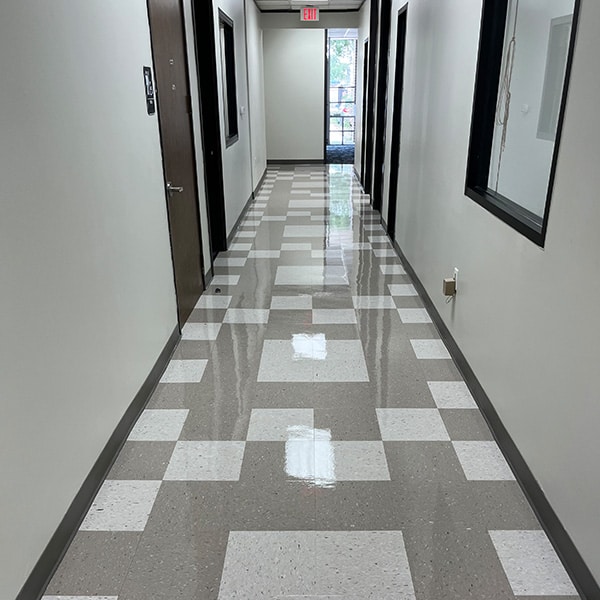
VCT, short for vinyl composition tile, is a resilient floor tile built mostly from ground limestone bound together with vinyl resin, plasticizer, and pigment, then pressed into thin, dense squares under heat. It is not the same product as luxury vinyl plank or sheet vinyl, even though all three get lumped together as "vinyl flooring" in everyday conversation. VCT is harder, more mineral than plastic, cheaper per square foot than almost anything else on the market, and built for a completely different kind of traffic than a residential living room typically sees.
We install VCT flooring across San Diego County for garages, workshops, home gyms, and light commercial spaces, and we install rubber flooring and tile for many of the same use cases depending on the traffic and budget. This guide explains what VCT actually is, why schools and hospitals rely on it, what the strip-and-wax maintenance cycle really involves, whether older tile might contain asbestos, and what VCT costs installed.
Considering VCT for a garage, workshop, or commercial space? Request a free in-home estimate or call +1 (619) 777-4334.
What Is VCT (Vinyl Composition Tile)?
VCT is a resilient flooring product manufactured to ASTM F1066, the industry specification for vinyl composition floor tile. It is sold almost universally as 12 inch by 12 inch tiles, with 12x24 available from some manufacturers, in a standard commercial gauge of 1/8 inch (.125 inch) and a lighter-duty gauge of 3/32 inch (.094 inch) for lower-traffic applications. Because it is a mineral-heavy tile rather than a plastic sheet, individual tiles can be pulled up and replaced one at a time without disturbing the rest of the floor, which is a big part of why facility managers specify it.
VCT should not be confused with VAT (vinyl asbestos tile), the asbestos-containing predecessor that VCT replaced, or with modern rigid-core luxury vinyl plank, which is a click-lock floating floor with a printed wear layer and no mineral filler. Armstrong's Standard Excelon line and Tarkett's equivalent commercial tile are the two products most schools, hospitals, and retail chains specify today, and both are manufactured asbestos-free under current ASTM standards.
What Is VCT Actually Made Of?
VCT is roughly 85 percent ground limestone (calcium carbonate) filler by weight, which is why the tile feels dense and cool underfoot compared to a plastic-heavy vinyl plank. The remaining material is a vinyl (PVC) resin binder that holds the limestone particles together, a plasticizer that keeps the tile flexible enough to install and walk on without cracking, stabilizers that resist UV yellowing and heat, and pigment for color. All of that gets blended, calendared into sheet form under heat and pressure, and cut into tiles.
That composition is exactly why VCT behaves so differently from other resilient flooring. The high mineral content makes it dense, heavy, and resistant to gouging from rolling loads like carts and gurneys, but it also means VCT has no factory wear layer of its own. Every bit of gloss and scratch resistance you see on a finished VCT floor comes from a separate acrylic floor finish applied on top after installation, not from the tile itself. That single fact is the reason VCT needs the maintenance routine covered further down this page.
Why Do Schools, Hospitals, and Retail Stores Use VCT?
VCT dominates institutional flooring for a combination of reasons that rarely all line up in one material at once: low material cost, mineral-based fire resistance, tile-by-tile repairability, and a color and pattern range wide enough to color-code an entire building.
- Cost per square foot. At $1 to $3 per square foot for material alone, VCT is one of the cheapest hard-surface floors available, which matters enormously when a school district or hospital system is covering hundreds of thousands of square feet across multiple buildings.
- Fire performance. Because VCT is mostly mineral filler rather than plastic, it performs well in the critical radiant flux flooring fire test referenced by NFPA 253, a factor building codes weigh heavily in schools, hospitals, and other occupied public buildings.
- Rolling load durability. Hospital gurneys, library book carts, and retail restocking carts put constant point-load stress on a floor. VCT's dense limestone body resists denting and gouging far better than a softer vinyl sheet product would under the same load.
- Spot repairability. A single cracked or stained tile can be popped out and replaced in minutes without shutting down a hallway or classroom, unlike sheet vinyl or carpet, which usually require a much larger patch or a full room replacement.
- Color and pattern range. VCT comes in dozens of solid colors and speckled patterns, which is how hospitals color-code departments and how schools mark hallway zones without signage.
The tradeoff for all of that is upkeep. VCT is the reason building custodial staff exist in the numbers they do, since the tile only looks and performs the way it's supposed to when the finish on top of it is maintained on a schedule.
VCT Pros and Cons
Pros of VCT Flooring
- Very low material cost. VCT is one of the least expensive hard-surface flooring materials per square foot, which makes it attractive for large garages, workshops, and commercial buildouts.
- Extremely durable body. The dense limestone core resists gouging, denting, and rolling-load damage better than most vinyl products.
- Repairable tile by tile. Damaged tiles can be individually replaced instead of patching or replacing an entire floor.
- Fire resistant by composition. The high mineral content gives VCT a favorable fire rating compared to plastic-heavy flooring, which matters in commercial code compliance.
- Huge color and pattern selection. Dozens of solid and speckled colors are available off the shelf from major manufacturers.
Cons of VCT Flooring
- No factory wear layer. Unlike LVP or laminate, VCT has no built-in protective coating. It relies entirely on a topically applied finish that wears down and needs to be reapplied.
- Ongoing maintenance requirement. Full strip-and-wax service every 6 to 12 months in high-traffic commercial settings is standard, and skipping it leads to a dull, stained-looking floor even though the tile underneath is fine.
- Not waterproof at the seams. Individual tile seams can allow water to reach the adhesive and subfloor over time in constant-moisture areas, unlike a fully sealed sheet product.
- Cold, hard underfoot. The dense mineral body has none of the give that cork, carpet, or cushioned vinyl offers, which is part of why it rarely shows up in bedrooms or living rooms.
- Commercial look. Even in nicer colorways, VCT reads as an institutional or utility material rather than a residential design choice for most homeowners.
The Strip-and-Wax Maintenance Cycle Explained
Because VCT has no built-in wear layer, every commercial VCT floor depends on a topically applied acrylic floor finish for its shine, scuff resistance, and stain protection. New VCT typically gets 4 to 6 thin coats of finish applied after installation, each one buffed and allowed to dry before the next goes on. From there, the floor is maintained on a repeating cycle rather than left alone.
| Maintenance Step | Frequency | What It Does |
|---|---|---|
| Dust mopping / auto-scrubbing | Daily to weekly | Removes grit before it scratches the finish coat |
| Spray buffing / burnishing | Weekly to monthly | Restores gloss to the existing finish without stripping it |
| Recoat (top-scrub and recoat) | Every 3 to 6 months | Adds a fresh finish layer over the worn top coat |
| Full strip and rewax | Every 6 to 12 months | Removes all old finish down to the tile and applies a full new finish system |
Schools are the clearest example of this cycle in action: most districts schedule a full strip and rewax of every VCT hallway and classroom during summer break, when the building is empty long enough for the stripping chemicals to work, the floor to dry, and 4 to 6 new coats to cure before students return in the fall. Hospitals and retail stores that cannot close typically do sections overnight in rotation instead. Commercial strip-and-wax service runs about $0.30 to $0.75 per square foot per full cycle, which adds up fast across a school district's total square footage but is still far cheaper than replacing the floor.
In a residential garage, workshop, or home gym application, traffic is far lower than a school hallway, so VCT rarely needs the full commercial cycle. A finish coat every 1 to 2 years, with regular sweeping and occasional damp mopping in between, is usually enough to keep a homeowner's VCT floor looking maintained. Skipping finish maintenance entirely does not damage the tile itself, since the limestone body underneath is inert, but the floor will look dull, scuffed, and stained well before the tile would actually wear out.
Does VCT Flooring Contain Asbestos?
Modern VCT manufactured under current ASTM F1066 standards does not contain asbestos. The concern homeowners run into is with older vinyl floor tile, specifically vinyl asbestos tile (VAT), which was widely manufactured before 1985 and can look nearly identical to modern VCT at a glance, same 12x12 inch format, same mineral-heavy feel underfoot.
If a test comes back positive, a licensed asbestos abatement contractor, not a flooring installer, is who should remove or encapsulate the material, following state and federal handling rules. Once a floor is confirmed asbestos-free or has been properly abated, installing new VCT, LVP, or tile over it proceeds like any other flooring project. VCT's own manufacturing standard, ASTM F1066 (published by ASTM International), has not permitted asbestos as an ingredient for decades, so this is strictly a concern with older existing tile, not with new material being installed today.
How Much Does VCT Flooring Cost?
VCT is one of the least expensive hard-surface flooring options per square foot, both in material and installed pricing. Costs below include tile, commercial-grade adhesive, and standard installation labor, but not the initial finish coats or ongoing strip-and-wax service, which are typically billed separately for larger commercial jobs.
| Item | Cost/sqft | 500 sqft Total |
|---|---|---|
| VCT material only | $1.00 - $3.00 | $500 - $1,500 |
| VCT fully installed (tile, adhesive, labor) | $2.00 - $5.00 | $1,000 - $2,500 |
| Initial finish coats (4 to 6 coats) | $0.25 - $0.50 | $125 - $250 |
| Full strip-and-wax service (per cycle) | $0.30 - $0.75 | $150 - $375 |
A typical residential job, a 400 to 600 square foot garage, workshop, or home gym, runs about $800 to $3,000 fully installed depending on tile grade and pattern complexity, and usually takes 1 to 2 days including subfloor prep and adhesive cure time. That is meaningfully cheaper than porcelain tile or rubber flooring for the same square footage, though both of those hold up better without a recurring finish routine. We install VCT and its alternatives across San Diego County, including garage and workshop conversions in San Diego and San Marcos. Our free in-home estimate lays out the real cost difference between VCT, rubber, and tile for your specific space before you decide.
Frequently Asked Questions
What Is VCT Flooring Made Of?
VCT is made from roughly 85 percent ground limestone filler bound with vinyl (PVC) resin, plasticizer for flexibility, stabilizers, and pigment for color, pressed into tiles under heat and pressure. It has no built-in wear layer, so all of its shine and scratch resistance comes from a topical finish applied after installation.
Is VCT Flooring the Same as Vinyl Plank Flooring?
No. VCT is a mineral-heavy tile, roughly 85 percent limestone, with no factory wear layer and no click-lock edges. Luxury vinyl plank is a plastic-based, click-lock or glue-down floating floor with a printed design layer and a built-in urethane or ceramic-bead wear layer. They look similar in some colorways but perform very differently.
Does VCT Flooring Contain Asbestos?
Modern VCT manufactured under current ASTM F1066 standards does not contain asbestos. Older vinyl floor tile made before 1985, often called VAT (vinyl asbestos tile), can contain asbestos and should be tested by a certified lab before sanding, scraping, or removing it.
How Often Does VCT Flooring Need to Be Stripped and Waxed?
High-traffic commercial VCT, like school hallways and hospital corridors, typically gets a full strip and rewax every 6 to 12 months, with lighter maintenance like spray buffing in between. Residential VCT in a garage or workshop sees far less traffic and usually only needs a fresh finish coat every 1 to 2 years.
How Much Does VCT Flooring Cost Installed?
VCT typically costs $2 to $5 per square foot fully installed, including tile and commercial-grade adhesive. A 400 to 600 square foot residential garage or workshop project usually runs $800 to $3,000 total, not including the initial finish coats.
Is VCT Flooring Good for a Home?
VCT works well in garages, workshops, home gyms, and laundry rooms where its low cost and durability against rolling loads and impact matter more than looks. For finished living areas, most homeowners get a better long-term result from LVP or porcelain tile, since VCT needs ongoing finish maintenance that most residential spaces don't get on a schedule.
Can VCT Flooring Be Installed Over Concrete?
Yes, VCT is commonly installed directly over a properly prepared concrete slab. The slab needs to be clean, flat, and tested for moisture before adhesive goes down, the same slab prep required for most resilient flooring installations.
How Long Does VCT Flooring Last?
The tile itself can last 20 to 30 years or longer since the limestone body doesn't wear out the way a surface finish does. In practice, how long a VCT floor looks good depends almost entirely on whether the strip-and-wax maintenance schedule is kept up, not on the tile's own lifespan.